BanG Dream! Girls Band Party!
- 3.6
- Rating
- 5.00M
- Installs
- Free
- Price

 Analysis by App-foxy
I came to BanG Dream! Girls Band Party! expecting a straightforward anime music game, but its appeal is wider than simply tapping notes to songs. It combines rhythm play with a character-focused world, so the first few sessions feel like both a musical challenge and an introduction to a large cast. The basic idea is easy to understand: listen, watch the note patterns, and tap in time. That accessibility is a major reason it works well on a phone.
It is a free game from Bushiroad International Pte Ltd_ in the music category, rated Everyone. The game has been available since Apr 3, 2018, and its current version is 8.4.1. On compatible Android devices, it requires Android 7.0 or later. Those details matter because this is not a tiny one-evening download; it is an established title with a substantial ongoing audience, reaching over five million installs and an average rating of 3.6 from around 161 thousand ratings.
Why the first week feels so inviting
I find the opening especially inviting because it lets me learn the tapping rhythm before asking me to care about every part of the wider game. In this section, I’d focus on choosing a comfortable chart and noticing whether the anime cast and song presentation make me want to stay. That first impression sets up the more important question of what keeps the game worthwhile once the controls feel familiar.
You May Also Like

 Blood Strike: 2.5 Anniversary
Blood Strike’s Loadouts Turn Every Drop Into a Tactical Gamble
A close look at Blood Strike’s custom loadouts: how fast access to signature weapons reshapes its battle royale rhythm, rewards preparation, and narrows the gap between fights.

 Pandora - Music & Podcasts
Pandora’s Music Is Easy to Start, but Harder to Recover
Pandora’s strength is its low-effort path from a seed to a station. Its weak spot is how much confidence it asks you to place in connection, setup, and quiet recovery.

 8 Ball Pool
 Is Built on Rivalries, Rematches, and Routine
A close look at the rivalries, rematches, shared routines, and unanswered safety questions that turn a quick pool match into a persistent mobile community.

 Samsung Music
’s Quiet Strength Is Playing What You Already Own
Its reach comes less from spectacle than from dependable access to a personal library. That simplicity is both the app’s strongest retention engine and its ceiling.

 AccuWeather: Weather Radar
AccuWeather Review: A Quick, Clear Forecast for Everyday Decisions
For everyday plans, the best forecast is the one you can understand quickly. AccuWeather makes rain timing, radar, and local conditions easy to act on, with a few trade-offs.

 Hill Climb Racing
Why Hill Climb Racing Still Turns Crashes Into One More Run
A tiny car, a bumpy hill and one more upgrade: Hill Climb Racing keeps resurfacing because its simple chaos makes every near-miss feel personal.
More From Our News Desk



Simple controls with room to improve
The opening experience is friendly because the controls do not ask me to learn a complicated interface before playing. Notes arrive along a lane, and the essential actions are familiar enough that I can begin immediately. That makes the game suitable for short breaks, especially when I want something more active than passively listening to music but less demanding than a full console game.
The simplicity is not the same as a lack of challenge. Early songs let me concentrate on timing and learn how the lanes behave, while harder charts demand better visual reading, quicker reactions, and more consistent hand movement. I like that progression because it gives the first week a natural rhythm: play casually, find a comfortable difficulty, then retry a favorite track when I feel ready to improve.
One useful habit is to avoid jumping straight to the hardest available setting. In this game, a song can feel manageable during its opening measures and then become much more demanding when patterns change. I get more value by learning one level thoroughly, noticing where I lose timing, and only then moving upward. That approach also reduces the frustration of treating every missed note as a failure.
The anime presentation does real work
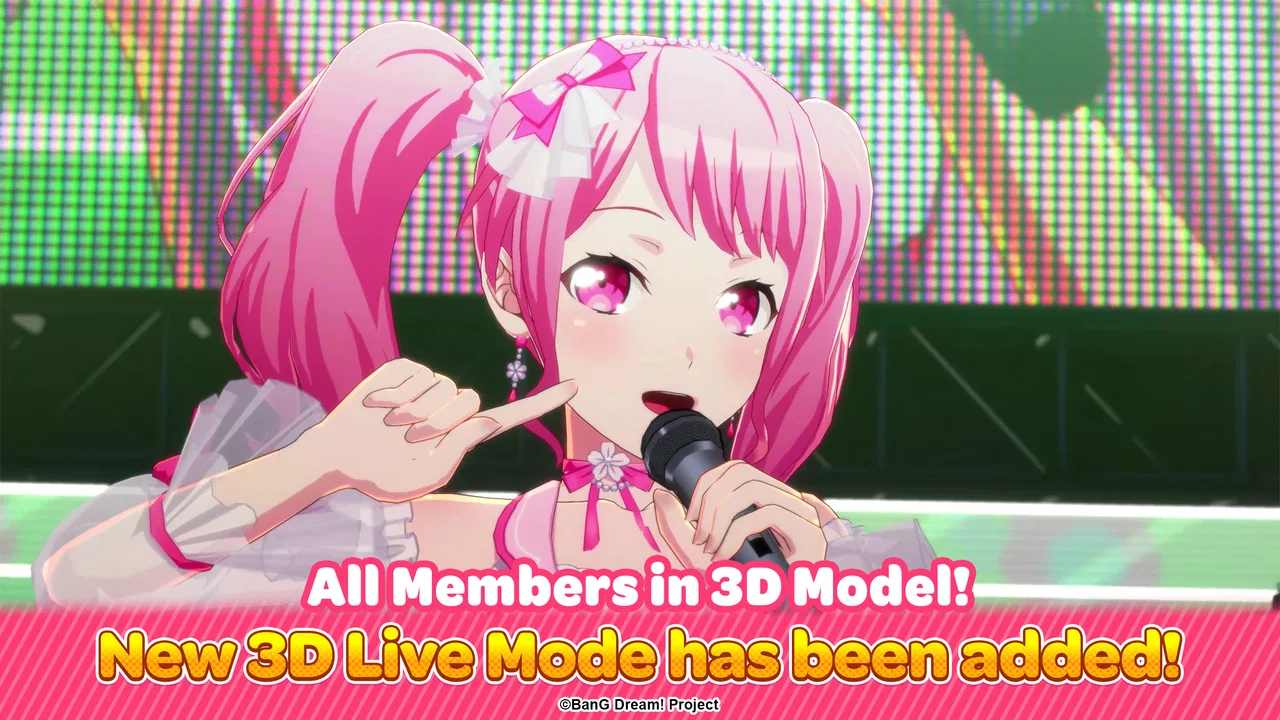
The anime style is not just decoration placed around a generic rhythm system. It gives the songs and performers a sense of context, which makes me more likely to remember individual tracks and return to particular groups. The story material also provides a slower counterpoint to the concentration required during performances. When I am tired of tapping, I can spend time with the character side instead of leaving the game immediately.
That combination is especially effective for players who enjoy music games because of their personalities, visual identity, and atmosphere rather than because they are chasing perfect scores. Someone who only wants an abstract rhythm challenge may find the surrounding presentation slower than necessary, but fans of anime-style casts will probably appreciate having a reason to care about what comes between songs.
What makes the opening sessions different from other rhythm games
Compared with a minimal rhythm app, this title gives me a stronger sense of place and ownership. A simple alternative may open faster and focus more tightly on timing, while this game asks me to move between performances, character content, and progression screens. That extra structure can feel rewarding during the first week because there is always another small piece of the world to explore.
The trade-off is that the game is not as immediately pure as an arcade-style music app. If I only have two minutes and want one song without any surrounding decisions, a stripped-down alternative may be more convenient. BanG Dream! Girls Band Party! is better when I want a continuing hobby rather than an isolated musical reflex test.
A realistic everyday use case
My most natural use case is a short evening session after work or school. I can play a few songs, switch to story content when my attention drops, and stop without needing to complete a long campaign segment. On another day, I might use the same session to practice a familiar chart and focus on cleaner timing. That flexibility helps the game survive beyond the novelty of installation.
It also works well as a low-commitment routine. I do not need to reserve a full hour every time I open it, but I can still make progress through repeated small visits. The important distinction is that the game rewards regular contact with its different layers. If I ignore the character and progression elements entirely, the experience becomes much closer to a conventional tap game, and some of its personality is lost.
What remains valuable after the novelty fades
Once the initial discovery wears off, I think the lasting appeal depends on having a reason to return beyond simply clearing another song. I’d look at how a player can alternate between enjoying familiar tracks and working on a specific timing weakness, without turning every visit into a task list. That distinction leads naturally to the practical question of how to keep a routine enjoyable over time.
Month-to-month appeal depends on changing goals
The first week is powered by discovery. After that, the game has to answer a harder question: why open it again when the controls are already familiar? For me, the answer is goal-setting. I can play for songs, improve performance on charts I already know, follow the anime-style cast, or simply use it as a relaxing music break. Those goals are different enough to keep the experience from feeling identical every time.
Still, the long-term value is not automatic. Players who need a constant stream of radically different mechanics may eventually feel that the core action remains familiar. The game is strongest for people who enjoy refinement: learning timing, revisiting music, and becoming more attached to the presentation. It is less convincing for someone who expects every session to introduce a completely new type of play.
How to build a sustainable play routine
I find it helpful to separate casual listening sessions from improvement sessions. In a casual session, I choose songs I already enjoy and accept imperfect results. In an improvement session, I repeat one chart and pay attention to a specific weakness, such as reacting late to a dense sequence or losing accuracy when the pattern changes. This prevents the game from turning every launch into a vague attempt to “do better.”
Another practical choice is to keep the difficulty comfortable enough that I can finish songs consistently. Constantly failing at a level above my current ability can make the game feel harsher than it really is. A stable routine of successful plays, followed by occasional experiments with harder charts, gives me a better sense of progress and makes returning feel voluntary rather than obligatory.
The character side can support that routine too. Instead of clearing every available piece of content as quickly as possible, I prefer treating the story as a separate reason to return. That creates a useful change of pace: focused tapping one day, reading and exploring another. It is a small but important way to keep the game from becoming a single repetitive gesture.
Free access and spending pressure
The game is free to download and play, which makes trying it low-risk. It does include in-app purchases ranging from $0.99 to $114.99 per item. That wide range is worth keeping in mind before getting invested, particularly for players who are sensitive to collection-driven spending or who dislike feeling that progress is connected to purchases.
I would approach the store as optional rather than as part of the basic reason to install the game. The strongest test is simple: can I enjoy the music, practice charts, and follow the cast without treating every desirable item as necessary? If the answer is yes, the free entry point is appealing. If collecting becomes the main source of satisfaction, the financial side may become more important than the rhythm play itself.
Parents should also consider how the Everyone rating fits the individual player. The age label makes the game broadly approachable, but an Everyone rating does not remove the need to discuss spending habits on a shared device. Setting expectations before playing is more useful than assuming the rating alone will handle that conversation.
Who will find lasting value here
I would recommend it to someone who likes anime presentation, accessible rhythm controls, and games that can be played in short sessions. It is particularly suitable for a player who enjoys improving gradually rather than demanding expert-level difficulty at once. The combination of songs and character content gives casual players more to do than simply chase a score.
I would be more cautious with someone who wants a completely offline-feeling music tool, a tiny download with no ongoing management, or a purely competitive timing experience. This is a live, content-heavy style of game in spirit, and its appeal comes from returning to a broader ecosystem. A focused rhythm alternative may be better if the surrounding cast and progression are distractions rather than attractions.
Maintenance, friction, and the reasons fatigue can appear
I see fatigue as less about a single demanding feature and more about letting repeated tapping, competing goals, and optional purchases blur together. In this section, I’d consider how short sessions and a clear purpose can protect the fun, while recognizing that the game’s broader presentation will not suit everyone. Those trade-offs make it easier to decide whether its ongoing upkeep feels like welcome variety or unnecessary friction.
The real maintenance burden
The main maintenance burden is not learning the controls; it is keeping the experience organized in my own mind. There are songs to revisit, story material to follow, and progression choices that can compete for attention. When I return after a break, I may spend time deciding what I actually want from the session instead of immediately playing.
That is not necessarily a flaw, but it changes the kind of commitment the game asks for. A small puzzle game can be opened, solved, and closed with almost no mental overhead. Here, the reward is better when I remember which songs I enjoy, which skills I am practicing, and whether I am playing for relaxation or improvement. A simple personal rule helps: choose one purpose before starting and stop once that purpose is satisfied.
Version 8.4.1 shows that the game remains a maintained product rather than an abandoned release. For a long-running mobile title, that is encouraging, but maintenance also means the experience can feel like something I need to keep up with. I prefer returning on my own schedule instead of turning every update or new piece of content into an obligation.
Where fatigue comes from
The most obvious fatigue comes from repetition. Even when songs are enjoyable, the physical action remains based on timing and tapping. If I play for too long, the difference between a satisfying practice run and a tiring one becomes noticeable. Short sessions are not merely convenient here; they protect the part of the game that feels good.
There is also a psychological kind of fatigue. When a game presents many possible goals, I can start measuring the session by what I did not complete. That is especially unhelpful in a music game, where enjoyment should not depend entirely on clearing a checklist. I get a better experience when I treat the available content as a menu rather than a demand.
The anime presentation can create a separate divide. Players who connect with the characters may find the story sections comforting and motivating. Players who do not connect with that style may see them as interruptions between songs. There is no universal solution to that difference, so I would make the decision based on whether the cast and visual tone are genuinely appealing before committing to long-term play.
Practical ways to reduce frustration
First, I would adjust expectations around accuracy. Missing notes is useful information, not proof that the game is unfair. Replaying a chart after identifying one troublesome section is more productive than repeatedly selecting random songs and hoping performance improves by accident.
Second, I would avoid using the game as background entertainment while distracted. Rhythm charts reward attention, and half-listening while checking messages makes the controls feel less responsive than they are. If I only have divided attention, the story or a shorter session is a better choice than forcing a difficult performance.
Third, I would decide on a spending boundary before browsing optional purchases. The individual price range can begin at $0.99 but extend to $114.99 per item, so impulse decisions can vary considerably in impact. I find the game easier to enjoy when purchases remain a deliberate choice rather than a reaction to a temporary desire for a particular reward.
How it compares with the usual alternatives
Against a basic rhythm game, this title wins on personality and continuity. The music is tied to an anime-styled world, and the cast gives repeated sessions more emotional context. Against a story-first mobile game, it wins on direct interaction: I am not only reading or watching, but also actively performing songs. That middle ground is its clearest identity.
It loses to simpler alternatives in immediacy. A lightweight rhythm app may be preferable when storage, attention, or time is limited. It can also lose to a more specialized music game for players who care primarily about precision, competitive rankings, or a highly focused chart library. I would choose this one when the complete package matters more than any single dimension.
My long-term verdict
After the initial excitement settles, BanG Dream! Girls Band Party! earns lasting space only when I use its variety intentionally. The songs alone may not be enough for every player, and the character material will not appeal equally to everyone. But for someone who enjoys anime bands, repeatable rhythm practice, and a game that fits into short daily visits, the combination has staying power.
The rating of 3.6 from roughly 161 thousand ratings suggests a mixed public response rather than universal approval, and that feels understandable. The game has a clear identity, but that identity comes with commitments: a broader interface, optional spending, repeated practice, and a presentation that may be more important to some players than to others. Its audience of over five million installs shows that the format has reached a large community, though popularity alone does not make it the right fit for every phone or player.
My recommendation is to try it as a music-and-character hobby, not as a quick disposable app. Give the controls enough time to become comfortable, sample the story side, and notice whether you naturally want to return after the first burst of novelty. If you enjoy choosing a few songs, improving at your own pace, and spending time with the anime cast, it can become a pleasant recurring habit. If you want only instant songs with no surrounding maintenance, I would choose a leaner rhythm alternative instead.
In the end, the game’s strongest quality is balance: it can be casual without being empty, and it can be demanding without requiring every session to become a serious practice run. I would keep it installed for the flexible routine and the musical atmosphere, while staying disciplined about time and purchases. That makes it a worthwhile free game for the right player, but not an automatic recommendation simply because it is familiar or established.
FAQs for BanG Dream! Girls Band Party!
01What is BanG Dream! Girls Band Party! about?
BanG Dream! Girls Band Party! is a rhythm game featuring a variety of all-girl bands, each with its distinct musical style and storyline. Players tap along to a wide selection of J-Pop songs, unlocking new content and improving their skills as they progress through the engaging, anime-inspired narrative.
02Is BanG Dream! Girls Band Party! free to play?
Yes, BanG Dream! Girls Band Party! is free to download and play on both Android and iOS devices. However, it features in-app purchases for players who wish to enhance their experience by buying additional items, such as costumes or boosters, which can help in progressing faster within the game.
03What are the system requirements for BanG Dream! Girls Band Party!?
To install BanG Dream! Girls Band Party! on Android, you need a device with at least Android 5.0. For iOS, the game requires iOS 9.0 or later. Both platforms recommend a stable internet connection for optimal performance, as the game frequently updates with new content and events.
04Can I play BanG Dream! Girls Band Party! with friends?
Yes, BanG Dream! Girls Band Party! offers a multiplayer feature where you can team up with friends or other players online. You can participate in live shows and events together, which adds a social and competitive element to the gameplay, enhancing the overall experience.
05How often does BanG Dream! Girls Band Party! update with new content?
BanG Dream! Girls Band Party! regularly updates with new songs, events, and story content. These updates keep the game fresh and engaging, providing players with new challenges and opportunities to explore further into each band's unique storyline. Staying connected to the internet allows you to access these updates seamlessly.
Pros
- Engaging rhythm gameplay with diverse tracks.
- High-quality graphics and animations.
- Frequent updates with new content.
- Strong community and social features.
- Deep character development and stories.
Cons
- Requires a stable internet connection.
- Can be challenging for rhythm beginners.
- Large app size may impact storage.
- In-app purchases can be expensive.
- Battery consumption is relatively high.

BanG Dream! Girls Band Party!
Gallery